
Palmistry and Magical Rings
This article is part of the Divination Hub.
“Have also a ring of silver on the middle finger of the left hand, wherein is engraved the character of the spirit…” ---Joseph H. Peterson (ed.), Lemegeton, 2001
“Thou shalt have a ring of silver, and on the same finger, which is the least finger of thy left hand, thou shalt wear the same ring when thou workest by the crystal.”
---Drawing Spirits into Crystals attributed to Johannes Trithemius, Joseph H. Peterson (ed.), Esoteric Archives
Magical Rings and Finger Placement
The placement of a magical ring on a specific finger was not arbitrary – it drew from the chiromantic tradition, better known as palmistry. Chiromancy is the art of interpreting the lines and signs of the hand to reveal a person’s character, morals, inclinations, and fortune. It also assigns planetary rulerships to different fingers, which informed the placement of magical rings in grimoire rituals.
· In the Ars Goetia of the Lemegeton, the middle finger corresponds to Saturn, “the greater malefic” planet. Saturn governs the earth, its chthonic or underworldly spirits, and necromantic operations involving the dead and demons. More importantly, Saturn signals spiritual authority to bind and constrain spiritual forces.
· The left hand (Latin: sinistra) was traditionally considered passive, receptive, and feminine. By late antiquity and the Middle Ages, the left side was associated with nighttime, death, and sinister and underworldly forces. Wearing a ring on the left middle finger signals the spiritual authority to bind and constrain the sinister and underworldly spirits.
By contrast, in Trithemian and related crystal-scrying traditions, the little finger – ruled by Mercury – was chosen for the magical ring. Mercury governs communication, mediation, the intellect, and liminal movement between realms. A ring on the Mercury finger marks the operator as a Hermetic practitioner, seeking knowledge through visions and scrying rather than coercion.
Both the Saturnian and Mercurial traditions appear across the broader grimoire corpus, including the Clavicula Salomonis (Key of Solomon), Liber Juratus (Sworn Book of Honorius), and Pseudo-Paracelsian Archidoxes Magicae.
Chiromancy and Solomonic Magic
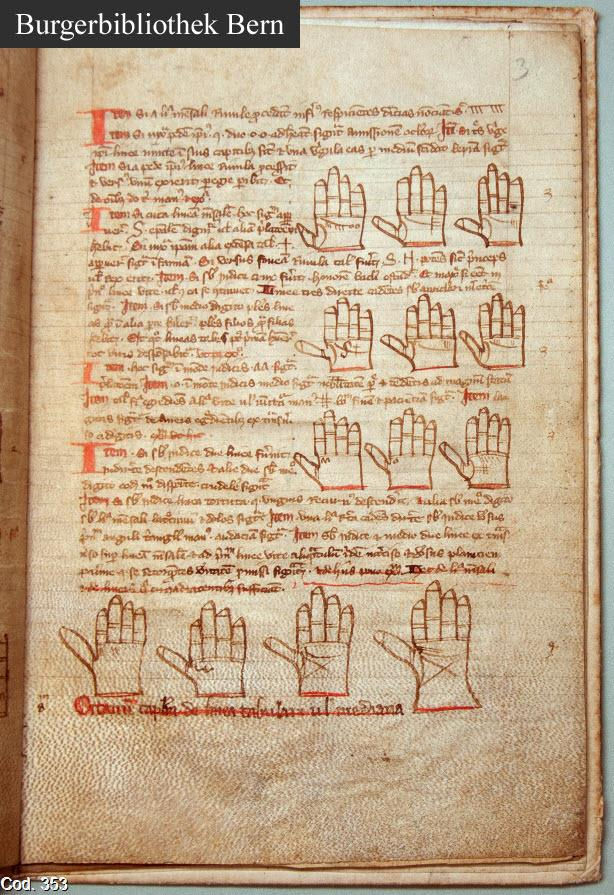
By the fourteenth century, European chiromantic works were falsely attributed to the legendary King Solomon, the great conjurer of spirits and magic, particularly in the Kingdom of France. One of the oldest treatises is called the Dextra Viri, Sinistra Mulieris (The Right Hand of a Man, The Left Hand of a Woman), a thirteenth century diagram illustrating the prognostications of the hand. A French variant, falsely attributed to King Solomon called the Palmistria Salomonis (The Palmistry of Solomon), demonstrates how magical authority and divination were intertwined.
Caption: Cambridge, Trinity College Library, O.2.5 (James number 1109), labeled Palmistria Salomonis (f. 190v-191v, explanation of the signs in French, colophon: Explicit tractus de Palmistria Salomonis), 14th century.
Though chiromancy lay at the fringes of the occult sciences, its influence on European grimoires was subtle but persistent. It provided a conceptual framework for symbolic correspondences (planet – finger) in magic. Incorporating chiromantic lore into the operator’s ritual apparatus reflects careful attention to the operator as a microcosm interacting with the macrocosm—planets, spirits, and the timing of magical operations.
Why Palmistry Matters
The next time you read about magical rings in the grimoires, consider its deeper meaning, and even if no finger is specified, ask yourself which finger would the chiromantic tradition inform the ritual.
This digital edition by Matthias Castle, Copyright 2026. All rights reserved.
Please do not copy this text to your website, or for any purpose other than private use.

Comments